Leading DC fast-charging technology


 Home >
Content Center>News>Articles
Home >
Content Center>News>Articles
May 12,2026
Source:DIMCO
Megawatt Charging System (MCS) is not just about higher charging power—it is about building charging infrastructure that can support heavy-duty electrification.
Heavy-duty charging is not simply passenger-car fast charging at a larger scale. Electric trucks and buses have larger batteries, tighter operating schedules, longer dwell-time requirements, and a much higher impact on site power planning. When one vehicle is delayed, it may affect an entire delivery route, fleet schedule, or depot operation.
That is why MCS-ready infrastructure needs to be planned as a complete site system rather than as individual charging units.
A heavy-duty charging site must consider vehicle size, turning radius, parking layout, cable reach, connector cooling, grid capacity, power allocation, and long-term maintenance access. These factors directly affect site utilization and operating efficiency.
Europe's Heavy-Duty Charging Challenge Is Increasingly About Grid Infrastructure
As heavy-duty electrification accelerates across Europe, more highway service areas, logistics hubs, ports, and fleet depots are beginning to plan for megawatt charging deployment.
However, many of the key bottlenecks for European heavy-duty charging projects are no longer related to charger power capability itself.
Instead, developers and operators are increasingly constrained by:
● Grid connection timelines;
● Available grid capacity;
● Distribution network upgrade costs;
● Site-level peak demand management;
● Integration of renewable energy and battery storage systems.
In some European markets, obtaining additional grid capacity can take several years, while the cost of grid reinforcement continues to rise. For many projects, the question is no longer whether a site can install a 1 MW charger, but whether the local grid can actually support multiple megawatt-scale charging sessions occurring simultaneously.
As more heavy-duty vehicles begin charging at the same location and during similar operating windows, load management becomes a critical factor for both technical feasibility and business viability.
The industry conversation is gradually shifting from: "How much charging power can be installed?" to: "How can limited grid resources be utilized most efficiently?"
This shift is driving growing interest in dynamic power allocation, energy management systems, battery storage integration, demand response strategies, and flexible charging operations.
Policy Is Accelerating Deployment, but Infrastructure Readiness Remains Uneven
The deployment of MCS infrastructure in Europe is being strongly supported by regulation.
Under the Alternative Fuels Infrastructure Regulation (AFIR), the European Union has established mandatory targets for heavy-duty charging deployment along the TEN-T transport corridors, creating a clear roadmap for the rollout of high-power charging infrastructure across member states.
At the same time, major truck manufacturers are accelerating their own electrification roadmaps and are preparing vehicles capable of megawatt charging.
This means charging infrastructure developers are facing a dual challenge:
They must support today's charging demand while preparing for tomorrow's vehicle requirements.
CCS2 and MCS Will Coexist for Years
The transition from CCS2 to MCS also matters. The market will not shift to MCS overnight. For a long period, many sites may need to support mixed charging demand: passenger cars, light commercial vehicles, buses, and heavy-duty trucks.
This means operators need infrastructure that can serve today's CCS2 demand while keeping room for future MCS growth.
Infrastructure decisions made today will likely remain in operation for ten to fifteen years or longer, making future scalability an essential consideration.
Flexible Site Planning Through Distributed Architecture
A distributed charging architecture can help address these infrastructure constraints.
By separating power cabinets from dispensers, distributed systems allow site planners to arrange charging points more flexibly while keeping power equipment scalable. This is especially useful for truck and logistics centers, highway service areas, bus fleet depots, ports, and industrial parks where space planning, power demand, and expansion needs can change over time.
As charging power levels continue to increase, the ability to dynamically allocate power between vehicles becomes increasingly valuable, particularly when available grid capacity is limited.
In this context, distributed systems are not only a charging architecture decision, but also an energy management strategy. Another important consideration is infrastructure lifecycle.
As charging demand evolves, many heavy-duty charging sites will inevitably require higher output power or different system configurations. Traditionally, meeting these new requirements often means replacing major hardware components—or even entire charging systems—resulting in unnecessary capital expenditure, electronic waste, and underutilized assets.
Building MCS-Ready Infrastructure with DiMCO MaxMod
At DiMCO, we see MCS as part of a broader shift in EV charging infrastructure. Future heavy-duty charging will require systems that are not only powerful, but also scalable, serviceable, and ready for mixed charging scenarios.
This is the thinking behind the DiMCO MaxMod Distributed Charging System. Built around a Power Cabinet + Dispenser architecture, MaxMod is designed to support high-power site planning with CCS2 and MCS-ready configurations, while giving partners more flexibility in layout, power distribution, and future expansion.
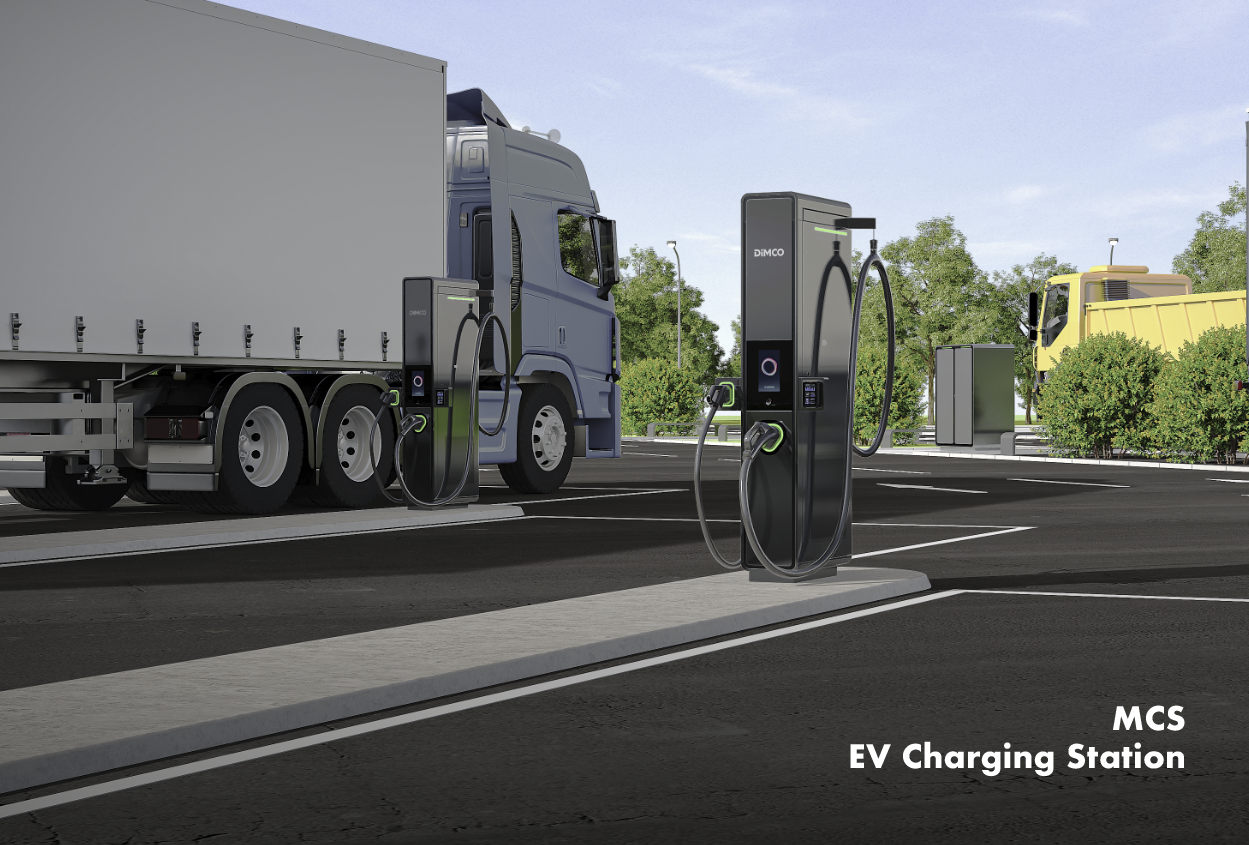
Its modular building-block architecture also enables infrastructure to evolve alongside market demand. As charging requirements increase, only the necessary functional building blocks need to be upgraded, while replaced modules can be reconfigured and redeployed for lower-power applications. This helps operators maximize asset value over the entire infrastructure lifecycle while reducing unnecessary replacement and waste.
In this sense, modularity is not only about simplifying deployment or enabling scalability—it is also about designing charging infrastructure that is upgradeable, reusable, and built for a circular lifecycle.
For local EV charging partners, this matters because heavy-duty charging is a long-term infrastructure investment.
A charging system should not only meet today’s demand. It should also be ready for future vehicles, higher charging requirements, changing standards, and new operating models.
The Real Questions Behind MCS
MCS is not just more power. It is a new infrastructure challenge — and an opportunity to build charging systems that are more flexible, scalable, and future-ready.
The real questions are broader:
● Can the site support heavy-duty vehicle movement?
● Can power be distributed efficiently?
● Can the system grow with demand?
● Can it support CCS2 today and MCS tomorrow?
The future of heavy-duty charging will not be defined by charger power alone.
It will be defined by how intelligently we design, manage, and optimize the energy infrastructure behind it.


